
Dry-Season & Air-Conditioned Skin Care: How to Protect Your Natural Moisture Barrier
Not only during dry autumn–winter months, people working 8 hours a day in air-conditioned offices year-round frequently experience tight, flaky skin on their legs and arms or post-shower itchiness. The root cause is a weakened skin barrier (Skin Barrier) leading to increased transepidermal water loss. This guide explains how to care for and protect your skin's natural moisture barrier.
1. Understanding the Hydrolipid Film and Transepidermal Water Loss (TEWL)
The outermost layer of the skin (the stratum corneum — Stratum Corneum) is structured like a “brick wall”: corneocytes act as the bricks, while natural intercellular lipids ( Ceramides, Cholesterol, and free fatty acids) serve as the mortar holding them together. Covering the stratum corneum is the Hydrolipid film with a naturally slightly acidic physiological pH ranging between pH 4.7 – 5.75 (averaging ~5.5).
2. 3 Showering Habits That Inadvertently Strip Your Skin's Natural Oils
- Showering with overly hot water for too long: On chilly days, many people take 15–20 minute showers at 42°C–45°C. Excessive water heat rapidly dissolves and washes away protective surface lipids, leaving skin flushed and tight right after stepping out.
- Using highly alkaline soaps or harsh detergents: Cleansers with alkaline pH (8–10) or high concentrations of harsh sulfates (like SLS) create heavy foam but disrupt the skin's acid mantle.
- Scrubbing aggressively with rough loofahs or dry towels: Strong friction causes micro-abrasions in an already dehydrated stratum corneum.

3. How to Choose a Gentle pH 5.5 Body Wash and Cleanser
To meet Skin & Personal Protection needs for the whole family when choosing products in the Skin & Body Care subcategory under Personal Carecategory, dermatologists recommend looking for these ingredient features:
- Balanced pH 5.5 & Free from Harsh Sulfates (SLS/SLES) and Parabens: Uses next-generation plant-sugar and coconut-derived surfactants such as Coco-Glucoside or Decyl Glucoside — effectively removing dirt and sweat while preserving post-shower softness.
- Colloidal Oat Extract (Avena Sativa Kernel Extract): Oats are rich in natural Beta-glucan and Avenanthramides that soothe dryness and itchiness while binding moisture to the skin surface—ideal for sensitive skin.
- Panthenol (Pro-Vitamin B5) and Plant Glycerin: Classic humectants that attract moisture and help restore a supple epidermal barrier.
- Green Tea Extract (Camellia Sinensis Leaf Extract): Rich in EGCG antioxidants to defend skin against environmental stressors.
4. The “Golden 3-Minute Rule” After Showering and Hydrating from Within
- Shower with lukewarm water (35°C–37°C) for 5–10 minutes: After showering, gently pat skin with a soft cotton towel (do not rub vigorously).
- Apply body lotion within 3 minutes: While skin is still slightly damp after patting dry is the “golden window” to apply body lotion and lock water molecules inside the stratum corneum.
- Hydrate and nourish from within: Well-hydrated skin requires drinking 1.5–2 liters of water and herbal electrolyte beverages daily, paired with antioxidant and collagen-supporting micronutrients from Vitamins & Minerals (such as Vitamin C, Vitamin E, Zinc) and Omega-3 fatty acids from nutritious nuts.
5. Bảng quy trình bảo vệ màng ẩm tự nhiên trong ngày cho người làm việc phòng máy lạnh
Kết hợp đồng bộ giữa làm sạch dịu nhẹ bên ngoài và cấp nước – vi chất từ bên trong theo lịch trình gợi ý dưới đây sẽ giúp hạn chế tối đa hiện tượng mất nước qua biểu bì (TEWL):
| Thời điểm trong ngày | Biện pháp chăm sóc bên ngoài | Biện pháp dinh dưỡng & Cấp ẩm bên trong |
|---|---|---|
| Buổi sáng trước khi đi làm | Rửa mặt bằng sữa rửa mặt pH 5.5 dịu nhẹ, thoa kem dưỡng ẩm mỏng và kem chống nắng phổ rộng | Uống 250 ml nước ấm; ăn sáng có chất béo tốt từ các loại hạt (hạnh nhân, óc chó giàu Vitamin E) |
| Trong giờ làm việc tại phòng điều hòa | Tránh ngồi đối diện trực tiếp luồng gió lạnh; thoa lại kem dưỡng da tay sau khi rửa tay | Uống đều đặn 150–200 ml nước lọc hoặc trà thảo mộc không đường mỗi 60–90 phút |
| Buổi tối (Quy tắc 3 phút sau tắm) | Tắm nước ấm nhẹ (35–37°C) không quá 10 phút với sữa tắm không chứa Sulfate gắt; thoa sữa dưỡng thể trong vòng 3 phút sau khi thấm khăn | Ăn tối đa dạng rau xanh đậm và trái cây giàu Vitamin C hỗ trợ tái tạo màng lipid biểu bì ban đêm |
6. When to Consult a Physician?
Mild weather-related dryness improves significantly with a pH 5.5 body wash and regular moisturizing. However, consult a dermatologist if you notice:
- Deep, bleeding fissures, burning pain, well-demarcated red plaques, or thick scaling on elbows, knees, or scalp.
- Intense nighttime itching disrupting sleep, tiny blisters, yellow oozing, or crusting (signs of secondary bacterial infection over atopic or contact dermatitis).
- Sudden generalized dry skin accompanied by fatigue, cold intolerance, hair loss, or weight changes — see an internist to check thyroid function or blood glucose.
- Never self-apply topical corticosteroid creams over large body areas long-term without a physician's prescription.
7. Nguồn tham khảo
- Harvard T.H. Chan School of Public Health — Vitamin E — Antioxidant Protection for Cell Membranes: https://nutritionsource.hsph.harvard.edu/vitamin-e/
- Harvard T.H. Chan School of Public Health — Water — Hydration and Physiological Functions: https://nutritionsource.hsph.harvard.edu/water/
- NHS (UK National Health Service) — Vitamin A and Vitamin E — Functions and Safe Intake: https://www.nhs.uk/conditions/vitamins-and-minerals/vitamin-e/
- Viện Dinh dưỡng Quốc gia — Bộ Y tế — Mười lời khuyên dinh dưỡng hợp lý giúp cơ thể khỏe mạnh: https://viendinhduong.vn/vi/proper-nutrition-and-health/muoi-loi-khuyen-dinh-duong
Gợi ý sản phẩm chính hãng liên quan chủ đề
Các sản phẩm dưới đây đang được phân phối chính hãng tại Lym với đầy đủ thông tin công bố nhãn hàng hóa:
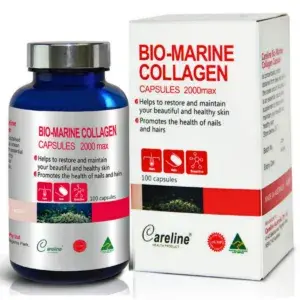
Careline Bio Marine Collagen 2000 mg |100 capsules| Bo sung Collagen chiet xuat tu da ca bien – Ho tro cham soc da/toc/mong [S/P Chuan Australia]
Original price was: 672.000₫.587.000₫Current price is: 587.000₫.